BREAKING: SOFTWARECol. LEAD STORY · Mar 2026
Developer Builds Music Platform That Connects Songs With Personal Stories
Full-stack application lets users share music, memories, and the meaning behind every track
Lumiere, a music-sharing platform designed to help people discover songs through personal experiences rather than recommendation algorithms.
Built with Next.js, React, Firebase, MongoDB, Supabase, and the Apple Music API, Lumiere lets users share songs alongside the stories behind them. The platform aims to make music discovery more personal by connecting people through meaningful experiences.
TECH & E-COMMERCECol. A2 · Jan 2025
Sam Launches SamShop, a Modern Fashion Platform Blending Style and Simplicity
E-commerce site curates streetwear collections with a focus on confidence, identity, and clean UI design
A fashion e-commerce platform designed to deliver a minimalist and style-driven shopping experience for modern streetwear users.
SamShop is a fashion e-commerce platform featuring curated collections of pants, shirts, and jackets in a clean grid layout with simple one-click shopping. It also includes a lifestyle section that links clothing to style identities like Sassy, Classy, and Elegant, emphasizing fashion as self-expression, along with About and Contact sections for brand mission and outreach.
BREAKING: AI & MACHINE LEARNINGCol. B1 · Nov 2023
Neural Network That Recognizes Handwritten Digits With 97.5% Accuracy
Feedforward model trained on MNIST dataset classifies digits 0–9 using deep learning fundamentals
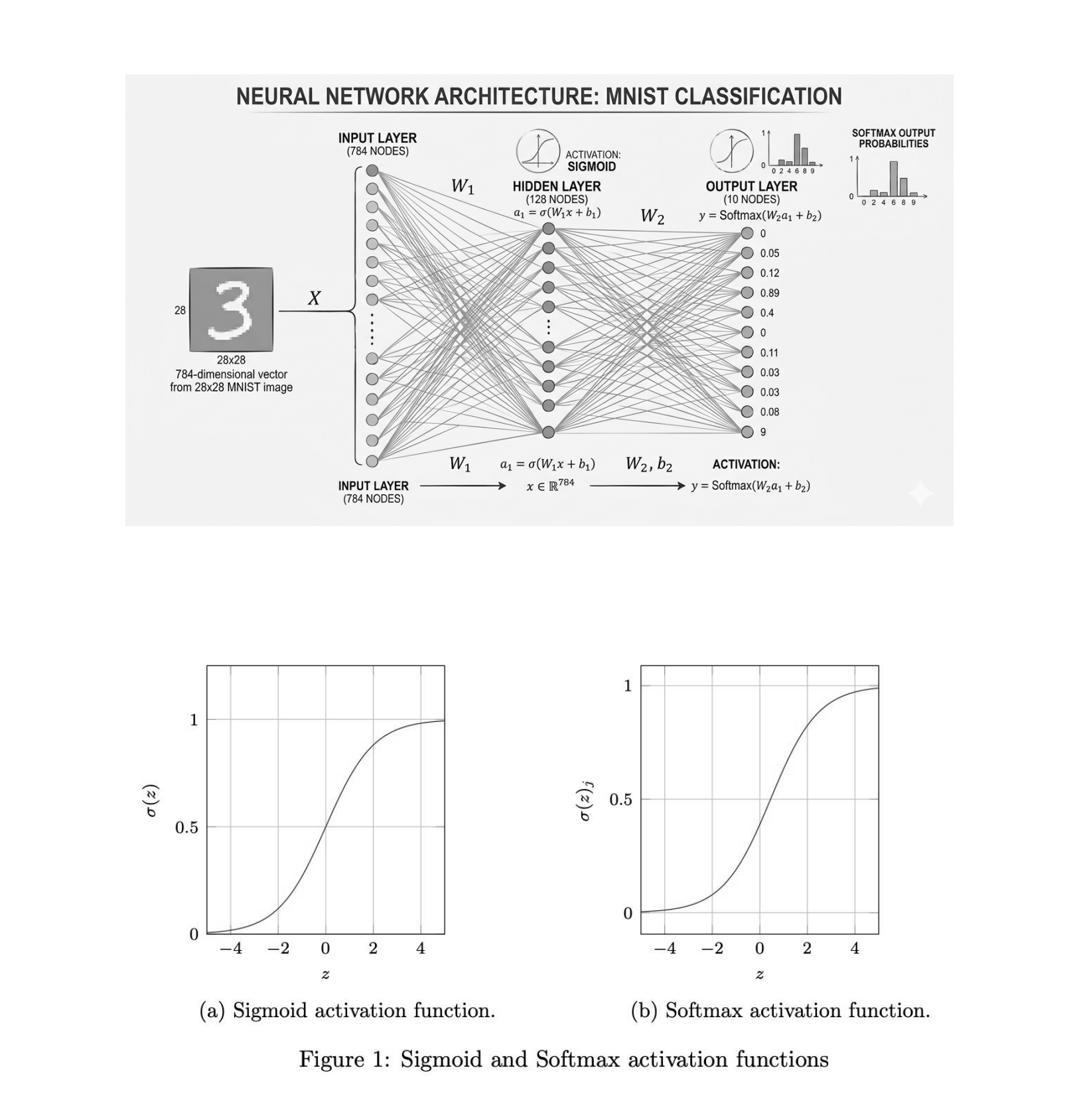
A simple feedforward neural network capable of recognizing handwritten digits with high accuracy using the MNIST dataset.
The model uses a feedforward neural network with one hidden layer (sigmoid) and a softmax output layer, trained on the MNIST dataset of 70,000 handwritten digit images. Each 28x28 image is flattened into a 784-dimensional vector and normalized before training. Using forward propagation, cross-entropy loss, and backpropagation with gradient descent, the model achieves about 97.5% accuracy, with most errors occurring between similar digits like 1 and 7 or 3 and 8.
BREAKING: AI RESEARCHCol. B2 · Jan 2026
Row-Anchored Distance Metric for Translation-Robust Digit Recognition
New method improves image similarity by aligning handwritten digits using stroke-based row anchors
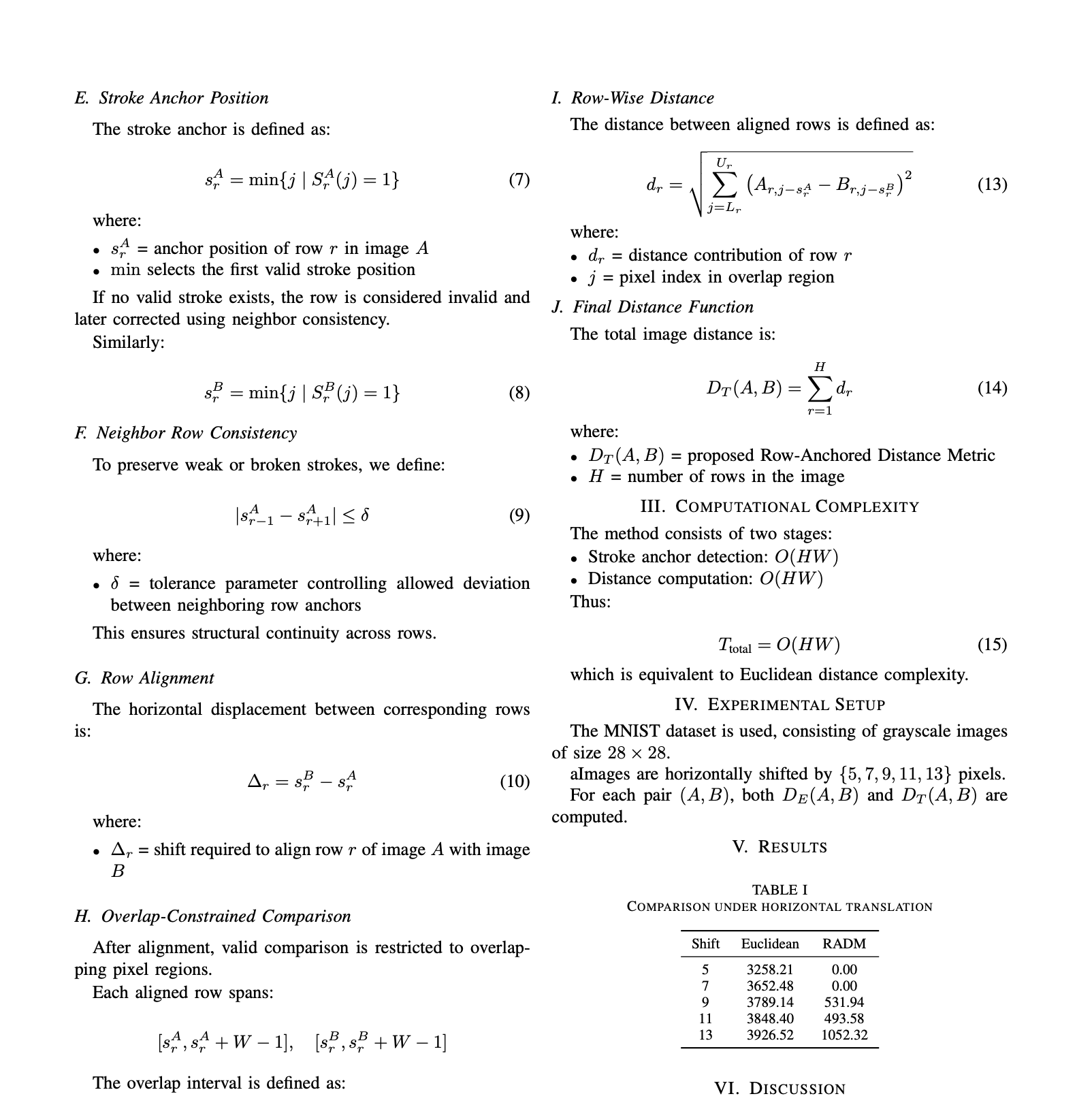
Sam has introduced a new image similarity method designed to improve robustness in handwritten digit recognition under horizontal translation.
The Row-Anchored Distance Metric (RADM) improves image similarity by aligning handwritten digits using row-wise stroke anchors instead of fixed pixel positions. This reduces sensitivity to horizontal translation while maintaining computational efficiency. Tests on translated MNIST data show RADM is more stable than Euclidean distance, especially under small to moderate shifts, where traditional methods degrade significantly.
BREAKING: AI & ROBOTICSCol. A1 · Jan 2026
Motion-Aware Drone Navigation System Learns to See Without Depth Sensors
Monocular vision system enables real-time navigation using motion tracking, velocity weighting, and occupancy prediction
A real-time drone navigation framework that operates using only a monocular RGB camera, avoiding LiDAR and stereo depth sensors.
This project introduces a vision-based autonomous navigation pipeline for drones that relies on classical computer vision and motion reasoning instead of deep learning or depth sensors. The system integrates motion detection via frame differencing, centroid-based object tracking, weighted velocity estimation for stable motion modeling, and motion-consistency-based object grouping to reduce fragmentation in dynamic scenes. A dynamic occupancy grid is constructed from predicted trajectories to model risk zones, enabling safe corridor generation for navigation. The decision engine uses risk scoring based on object speed and proximity to adjust movement in real time, allowing the drone to slow down, stop, or proceed safely. This approach demonstrates that lightweight vision systems can achieve reliable navigation behavior without expensive sensing hardware.